
Sau VSTEP Speaking part 1, bạn sẽ chuyển qua VSTEP Speaking part 2. Ở phần này, bạn sẽ nhận được những tình huống cụ thể, từ đó đưa ra những quan điểm và ý tưởng để giải quyết vấn đề. Cùng tìm hiểu và tham khảo những tình huống và câu trả lời thường gặp trong VSTEP Speaking part 2 để đạt được điểm cao nhé.

VSTEP Speaking Part 2: Tổng quan bài thi
VSTEP (Vietnamese Standardized Test of English Proficiency) là kỳ thi đánh giá năng lực tiếng Anh theo tiêu chuẩn của Việt Nam. Bài thi VSTEP Speaking Part 2 là một phần quan trọng trong bài thi VSTEP để đánh giá kỹ năng nói của thí sinh. Phần này yêu cầu thí sinh trả lời các câu hỏi phức tạp hơn và trình bày quan điểm cá nhân về một chủ đề cụ thể.
Thí sinh được đưa cho 1 vấn đề/tình huống kèm theo 3 gợi ý xử lý. Thí sinh sẽ chọn 1 gợi ý phù hợp nhất, giải thích cho nó và đưa ra ý kiến giải thích/phản bác vì sao không chọn 2 ý kiến còn lại.
Ví dụ: Your friend who is a teacher complains that many her students do not do homework. She is considering the punishment among three options: ask the students to rewrite the task 10 times, require them to stand at the classroom corner for one hour, or ask the students give some money. Which do you think is the best choice?
Thí sinh sẽ phải sử dụng các gợi ý này để phát triển ý tưởng và trình bày quan điểm của mình về chủ đề.
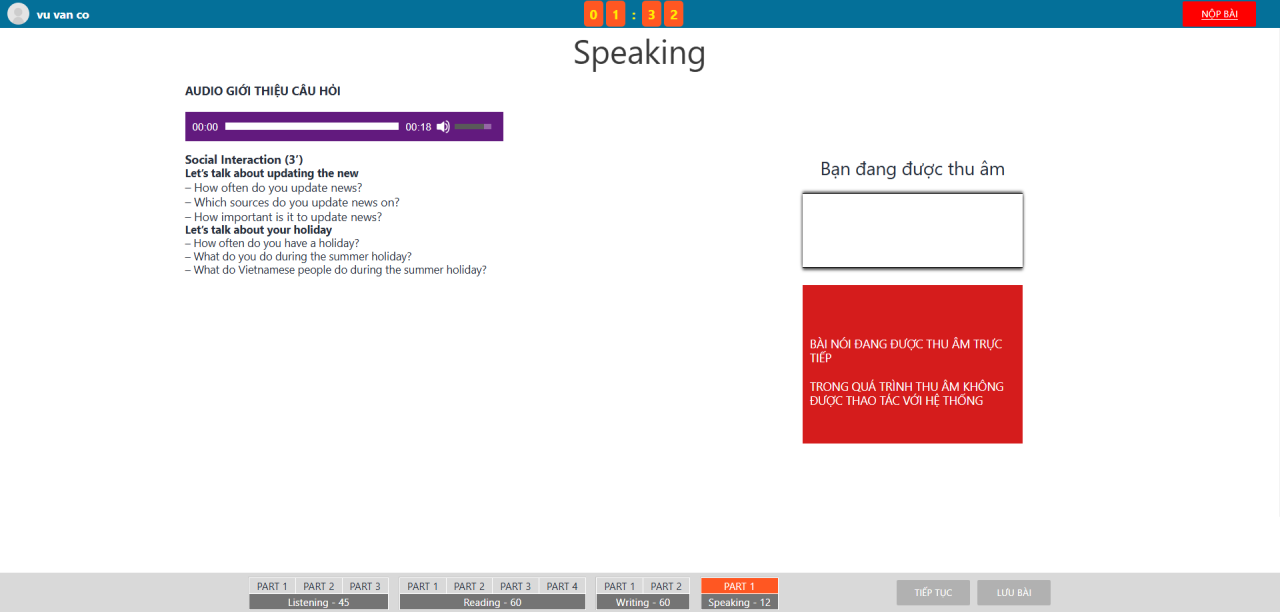
Quá trình thi Vstep Speaking Part 2 sẽ diễn ra trong vòng 3 phút:
- Chuẩn bị (Preparation): Giám khảo sẽ đưa ra một chủ đề và các gợi ý. Thí sinh có 1 phút để chuẩn bị.
- Trình bày (Presentation): Thí sinh có 2 phút để nói về chủ đề đã được đưa ra, phát triển ý tưởng và trình bày quan điểm cá nhân.
Thi VSTEP Speaking Part 2 đánh giá qua tiêu chí nào?
Để đạt được kết quả tốt trong bài thi Speaking VSTEP Part 2, thí sinh cần chú ý đến các tiêu chí đánh giá cụ thể. Dưới đây là 2 tiêu chí đánh giá Vstep Speaking Part 2 và các yêu cầu cụ thể cho từng tiêu chí. Các tiêu chí nhỏ được đánh giá với thang điểm 0 – 0.5 – 1 điểm.

Đánh giá năng lực giao tiếp
Về đánh giá năng lực giao tiếp, điểm thi của thí sinh sẽ được đưa ra dựa trên các tiêu chí sau:
Giới thiệu được tình huống và đưa ra lập luận, lý giải, giải pháp cho vấn đề:
Đây là khả năng của thí sinh để biết cách bắt đầu câu chuyện một cách logic và hấp dẫn, giới thiệu tình huống một cách rõ ràng và có cấu trúc. Thí sinh cần có khả năng phân tích và đưa ra lập luận logic, cung cấp các lý giải rõ ràng về vấn đề đã được đặt ra trong đề thi.
Ngoài ra, khả năng đưa ra các giải pháp hiệu quả cũng rất quan trọng để thể hiện khả năng suy nghĩ sáng tạo và xử lý vấn đề của thí sinh.
Bảo vệ được quan điểm của mình khi giám khảo phản bác ý kiến:
Điều quan trọng trong bài thi Vstep Speaking Part 2 là việc thí sinh bảo vệ được quan điểm mình đưa ra. Khi thí sinh phải đối đầu với các câu hỏi phản biện từ giám khảo, khả năng bảo vệ quan điểm của mình trở nên rất quan trọng.
Vậy nên, thí sinh cần có khả năng lập luận thuyết phục, cung cấp lập luận và chứng minh để bảo vệ và khẳng định quan điểm của mình một cách rõ ràng và logic. Điều này yêu cầu thí sinh có khả năng tự tin, không bị áp lực và có thể sử dụng các lập luận hợp lý để phản biện lại các ý kiến khác.
Đánh giá năng lực sử dụng ngôn ngữ
Để đánh giá năng lực sử dụng ngôn ngữ, giám khảo chấm điểm sẽ dựa trên các yếu tố về từ vựng, ngữ pháp, ngữ âm trong bài thi Vstep Speaking Part 2 của thí sinh:
Từ vựng
Thí sinh cần sử dụng từ vựng phong phú, phù hợp với nội dung và chính xác về mặt ngữ nghĩa. Sự đa dạng trong việc sử dụng từ vựng cho thấy khả năng biểu đạt và phong phú của ngôn ngữ của thí sinh.
Ngữ pháp
Khả năng sử dụng ngữ pháp chính xác và đa dạng là yếu tố quan trọng khác. Thí sinh cần phải biết cách sử dụng các thì, cấu trúc câu và các mẫu ngữ pháp phù hợp với nội dung để truyền đạt ý nghĩa một cách rõ ràng và chính xác.
Ngữ âm
Trình bày của thí sinh cần được thực hiện trôi chảy, rõ ràng và phát âm đúng, dễ nghe. Điều này giúp cho người nghe có thể hiểu và lấy được ý chính của thí sinh một cách dễ dàng. Sự mạch lạc và rõ ràng trong ngữ âm cũng giúp tăng tính thuyết phục và thẩm mỹ của bài nói của thí sinh.
Bí quyết trả lời Speaking VSTEP Part 2 đạt điểm cao
Để đạt điểm cao trong bài thi speaking part 2 vstep, thí sinh cần chú ý đến một số bí quyết quan trọng sau:
Chuẩn bị gì trong 1 phút đầu tiên?
Trong 1 phút đầu tiên, thí sinh cần tận dụng tối đa thời gian để đọc kỹ chủ đề và các gợi ý đi kèm. Tiếp theo, ghi chú nhanh các ý chính và từ vựng liên quan, giúp hình dung rõ ràng về những điểm cần trình bày.
Một dàn ý sơ lược nên được lập ra, bao gồm mở bài, thân bài và kết bài. Điều này giúp thí sinh có khung sườn để dựa vào khi nói, tránh tình trạng lúng túng hoặc mất phương hướng trong quá trình trình bày.
Định hình bố cục bài nói trước khi trình bày
Xác định rõ ràng các phần mở bài, thân bài và kết bài. Trong phần thân bài, nên chia thành 2-3 ý chính, mỗi ý được phát triển rõ ràng với các ví dụ cụ thể. Sắp xếp các ý tưởng một cách logic, sử dụng từ nối để tạo sự mạch lạc giúp người nghe dễ dàng theo dõi và hiểu rõ các điểm thí sinh muốn trình bày.
Cách sử dụng ngôn ngữ so sánh trong câu trả lời
Sử dụng ngôn ngữ so sánh là một cách hiệu quả để làm rõ quan điểm và tạo sự phong phú cho bài nói. Thí sinh nên biết cách sử dụng các cấu trúc so sánh như “more… than…”, “less… than…”, hoặc đối chiếu các khía cạnh khác nhau của vấn đề.
Sử dụng ngôn ngữ so sánh không chỉ làm rõ ý kiến của thí sinh mà còn thể hiện khả năng sử dụng ngôn ngữ phong phú và linh hoạt.
Lưu ý lỗi lặp từ
Một trong những lỗi thường gặp khi nói là lặp lại từ ngữ đơn giản, điều này làm bài nói trở nên nhàm chán và thiếu sự phong phú. Thí sinh cần tránh lặp từ bằng cách sử dụng các từ đồng nghĩa và cụm từ tương đương.
Việc sử dụng từ vựng đa dạng không chỉ làm cho bài nói trở nên sinh động hơn mà còn thể hiện sự thành thạo về ngôn ngữ của thí sinh.

Cách phát triển nội dung cho bài VSTEP Speaking Part 2
Để phát triển nội dung cho bài thi VSTEP Speaking Part 2 một cách hiệu quả, thí sinh nên sử dụng chiến lược hỏi và trả lời hai câu hỏi quan trọng: “Why?” và “Why not?” Điều này giúp thí sinh có thể mở rộng ý tưởng và trình bày quan điểm một cách rõ ràng, mạch lạc.
Ví dụ chủ đề: Discuss the advantages of online learning.
Phát triển nội dung qua trả lời câu hỏi “Why?”
Vì bài thi Vstep Speaking Part 2 thường hỏi về quan điểm cá nhân của thí sinh nên một trong những cách phát triển nội dung hiệu quả nhất là đặt câu hỏi “Why”. Khi thí sinh chọn một phương án hoặc đưa ra một quan điểm, việc giải thích lý do “tại sao” là rất quan trọng. Câu hỏi “Why?” giúp thí sinh đi sâu vào các lý do đằng sau lựa chọn của mình, từ đó phát triển bài nói một cách chi tiết và thuyết phục hơn.
Câu trả lời có thể bắt đầu với: One significant advantage of online learning is its flexibility. Why? Because students can access lessons and materials at any time that suits them, which is especially beneficial for those who have busy schedules or are working part-time.
Phát triển nội dung qua trả lời câu hỏi “Why not?”
Sau khi đã giải thích lý do tại sao chọn một phương án, việc trả lời câu hỏi “Why not?” giúp thí sinh đánh giá các phương án khác và giải thích lý do tại sao chúng không được lựa chọn. Điều này không chỉ làm rõ quan điểm của thí sinh mà còn thể hiện khả năng phân tích và đánh giá tình huống một cách toàn diện, giúp bài thi Vstep Speaking Part 2 đạt điểm cao hơn.
Sau khi giải thích lợi ích của học trực tuyến, thí sinh có thể tiếp tục: Why not traditional classroom learning? While traditional classrooms offer face-to-face interaction, they lack the flexibility that online learning provides. This flexibility is crucial for students who need to balance their studies with other commitments.
Tổng hợp và kết nối ý tưởng
Bằng cách sử dụng hai câu hỏi “Why?” và “Why not?”, thí sinh có thể phát triển nội dung bài nói một cách logic và mạch lạc. Mỗi ý tưởng nên được mở rộng và giải thích chi tiết, kèm theo các ví dụ cụ thể để minh họa. Việc kết nối các ý tưởng này bằng từ nối và cụm từ chuyển tiếp sẽ giúp bài nói trở nên liên kết chặt chẽ và dễ hiểu.
Ví dụ tổng hợp: One significant advantage of online learning is its flexibility. Why? Because students can access lessons and materials at any time that suits them, which is especially beneficial for those who have busy schedules or are working part-time. Why not traditional classroom learning? While traditional classrooms offer face-to-face interaction, they lack the flexibility that online learning provides. This flexibility is crucial for students who need to balance their studies with other commitments. Additionally, online learning often includes a variety of multimedia resources that can enhance the learning experience.

12 Tình huống VSTEP Speaking Part 2 & Gợi ý trả lời
Dưới đây là 12 tình huống thường gặp và các tình huống cập nhật mới nhất. Các câu trả lời mẫu đã được biên soạn lại để đảm bảo ngữ pháp chuẩn xác, tự nhiên và loại bỏ các lỗi Vietlish thường gặp.
Sample 1: Lựa chọn quà tặng cho em họ (Laptop/Holiday/Money)
Câu hỏi: Your cousin is the best student of the class this year. His parents are thinking about a present, there are three options: a laptop, a holiday, or some money. Which option would you suggest her?
If I were in her shoes, I would strongly suggest choosing an incredible holiday as the reward. Here is why.
First and foremost, travel broadens the mind. A trip would allow her to immerse herself in new cultures, traditions, and local customs, which is an invaluable experience outside of textbooks. Secondly, after a year of hard work, she deserves a chance to unwind and recharge her batteries. A well-planned vacation offers both relaxation and education.
I would not choose the laptop because, while useful, it might become a distraction from her future studies or social life. As for the money, it is often spent quickly without leaving a lasting memory.
In conclusion, a holiday provides a unique mental and spiritual reward that material gifts simply cannot match.
🌟 Vocabulary Highlight:
- Immerse oneself in (v): Đắm mình vào (một nền văn hóa/môi trường).
- Unwind (v): Thư giãn, xả hơi (đồng nghĩa với relax nhưng hay hơn).
- Broaden the mind (idiom): Mở mang đầu óc.
Sample 2: Xử lý khi thấy con hàng xóm chơi game
Câu hỏi: You have seen your neighbor’s son playing games at the Internet shop many times. What will you do: inform his parents, talk to him, or talk to the shop owner?
Faced with this dilemma, I believe the most responsible course of action is to inform his parents.
The primary reason is that parents are the legal guardians and have the most influence over their child’s behavior. They can implement appropriate measures, such as adjusting his allowance or setting stricter curfews, to guide him back to the right path. Additionally, they have a right to know if their son is neglecting his studies.
I would rule out talking to the shop owner, as their main concern is profit, not the boy’s welfare. Talking to the boy directly might also be counterproductive, as he could simply move to another shop to avoid me.
Therefore, involving the parents is the most sustainable solution.
🌟 Vocabulary Highlight:
- Legal guardian (n): Người giám hộ hợp pháp.
- Counterproductive (adj): Phản tác dụng.
- Sustainable solution (n): Giải pháp bền vững/lâu dài.
Sample 3: Đi chơi tối Chủ nhật (Movie/Shopping/Karaoke)
Câu hỏi: You have a Sunday evening out with your friends. There are three suggestions: seeing a movie, going shopping or singing karaoke. Which one would you choose?
Among the three options, I would definitely choose going shopping for a Sunday evening out.
Firstly, shopping acts as a form of retail therapy. Wandering through malls, looking at window displays, and perhaps buying a few favorite items can be incredibly relaxing and fun for my group of friends. Secondly, it allows for more interaction. Unlike watching a movie where we have to sit silently, shopping gives us the chance to chat, advise each other on outfits, and strengthen our bond.
I wouldn’t choose the movie option because it’s often hard to find a film that everyone agrees on. As for karaoke, not everyone is comfortable performing in public, which could make some friends feel left out.
All things considered, shopping is the most flexible and social activity for us.
🌟 Vocabulary Highlight:
- Retail therapy (n): “Liệu pháp mua sắm” (mua sắm để xả stress).
- Bond (n/v): Sự gắn kết/ Gắn kết tình cảm.
- Left out (adj): Cảm thấy bị ra rìa, lạc lõng.
Sample 4: Thời điểm du lịch London (Spring/Summer/Winter)
Câu hỏi: You are going to travel to London. There are three suggestions of when to go there: spring, summer and winter. Which one would you choose?
If I were planning a trip to London, summer would be my top priority.
The main reason is the weather. London is notorious for being gloomy, but summer offers the best chance of sunshine and warmer temperatures, which is perfect for sightseeing and outdoor activities like strolling through Hyde Park. Furthermore, summer is the peak season for festivals and cultural events, allowing me to experience the city’s vibrant atmosphere to the fullest.
I would avoid winter because the biting cold and short daylight hours would severely limit my exploration. Spring is also risky due to its unpredictable rainfall, which could dampen the holiday spirit.
In short, summer provides the most favorable conditions for a memorable trip.
🌟 Vocabulary Highlight:
- Notorious for (adj): Khét tiếng/nổi tiếng (về cái gì đó xấu).
- Sightseeing (n): Hoạt động ngắm cảnh.
- Biting cold (collocation): Rét cắt da cắt thịt.
Sample 5: Hình phạt cho học sinh không làm bài tập
Câu hỏi: Your friend who is a teacher complains that many her students do not do homework. She is considering the punishment among three options: ask the students to rewrite the task 10 times, require them to stand at the classroom corner for one hour, or ask the students give some money. Which do you think is the best choice?
In this situation, asking the students to rewrite the task 10 times seems to be the most pedagogical approach.
Firstly, this punishment is directly related to the offense. By rewriting the task, students are forced to review the material they skipped, which helps reinforce their knowledge. It turns a punishment into a learning opportunity. Secondly, it requires effort and time, which will likely deter them from repeating the mistake.
I strongly oppose asking for money, as fining students is unethical and educational environments should not be commercialized. Standing in the corner is also inappropriate; it is humiliating and archaic, offering no educational value.
Therefore, rewriting the task is the most constructive and effective disciplinary measure.
🌟 Vocabulary Highlight:
- Pedagogical (adj): Thuộc về sư phạm/giáo dục.
- Deter (v): Ngăn chặn, làm nản lòng.
- Archaic (adj): Cổ lỗ sĩ, lỗi thời.
Sample 6: Chụp ảnh kỷ yếu (Formal/Informal/No photo)
Câu hỏi: Your friend’s class is discussing whether they should takes photo to celebrate graduation. They are considering three options: taking photo with formal clothes, taking photo with informal clothes, or taking no photo at all. Which do you think is the best choice?
I believe that taking photos with formal clothes is the best option to celebrate graduation.
Graduation is a milestone in every student’s life, marking the transition to adulthood. Formal attire, such as suits or traditional ao dai, reflects the solemnity and significance of this occasion. Moreover, wearing uniforms or formal clothes creates a sense of unity and equality among classmates, making the photos look professional and timeless.
Taking no photos is definitely out of the question, as they would regret having no keepsakes later. Informal clothes, while comfortable, might lack the gravitas required for such a ceremonial event.
Thus, formal attire strikes the perfect balance between celebration and respect for the occasion.
🌟 Vocabulary Highlight:
- Milestone (n): Cột mốc quan trọng.
- Solemnity (n): Sự trang trọng.
- Gravitas (n): Sự trang nghiêm, uy nghiêm.
Sample 7: Xử lý tình huống bị bắt nạt (Teacher/Parents/Friends)
Câu hỏi: You see a boy who is bullied. What will you do: talk to his teacher, talk to his parents, or talk with his friends?
In this urgent situation, talking to his teacher is the most immediate and effective solution.
Teachers have the authority to intervene directly within the school environment where the bullying likely occurs. They are trained to handle conflict and can monitor the situation daily to ensure the boy’s safety. Furthermore, a teacher can act as a neutral mediator between the bully and the victim.
Talking to parents might cause unnecessary panic or lead to overreactions that could embarrass the boy. Meanwhile, relying on friends is risky, as they lack the power to stop the bullying and the situation could easily escalate.
Therefore, the teacher is the best person to handle this professionally.
🌟 Vocabulary Highlight:
- Intervene (v): Can thiệp.
- Mediator (n): Người hòa giải.
- Escalate (v): Leo thang (tình hình trở nên tồi tệ hơn).
Sample 8: Quà sinh nhật cho bạn (Book/Clothing/Tickets)
Câu hỏi: You are considering a birthday present for a friend. A clothing item, a book, a pair of tickets.
Knowing my friend well, I am convinced that a book is the perfect choice.
Firstly, a book has lasting value. Unlike other gifts, she can keep it forever, re-read it, and gain knowledge or entertainment whenever she wants. It shows that I understand her intellectual interests. Secondly, books are excellent for relieving stress. Getting lost in a good novel is a healthy way for her to escape from her busy academic life.
Clothing is too risky because style and size are very personal; I might buy something that doesn’t fit or suit her taste. Movie tickets are fleeting, and finding a time and movie that suits both of us can be a logistical headache.
In summary, a book is a thoughtful, personal, and enduring gift.
🌟 Vocabulary Highlight:
- Lasting value (n): Giá trị lâu dài.
- Intellectual interests (n): Sở thích trí tuệ (đọc sách, nghiên cứu…).
- Logistical headache (n): Vấn đề đau đầu về mặt sắp xếp/tổ chức.
Sample 9: Quà chia tay du học (Book/Album/Scarf)
Câu hỏi: You choose a gift for a friend who is going to study abroad. A book, a self- designed photo album, a silk scarf.
For a friend embarking on a journey abroad, a self-designed photo album is undoubtedly the most meaningful gift.
The primary reason is its sentimental value. Living in a foreign country can be lonely, and having a collection of memories with friends and family will help alleviate her homesickness. It serves as a source of emotional support during tough times.
I would rule out the book because textbooks and luggage already take up too much weight, and she might not have time for leisure reading. A silk scarf, while nice, is seasonal and might not be practical depending on the climate of the destination.
Therefore, a photo album is a unique keepsake that carries emotional weight, which is exactly what she needs.
🌟 Vocabulary Highlight:
- Sentimental value (n): Giá trị tinh thần/tình cảm.
- Alleviate (v): Làm giảm bớt (nỗi đau/bệnh tật).
- Homesickness (n): Nỗi nhớ nhà.
Sample 10: Lựa chọn nghề nghiệp (Receptionist/Operator/Tourism Agent)
Câu hỏi: You have to decide among 3 types of jobs: a telephone operator, a hotel receptionist and a tourism agent. Which one do you choose?
If I had to choose, working as a tourism agent would be my ideal career path.
This job offers dynamic opportunities to travel and explore new destinations, which aligns perfectly with my passion for discovery. It allows me to broaden my horizons regarding different cultures and languages. Furthermore, creating memorable travel experiences for clients gives me a sense of job satisfaction that other roles cannot match.
Being a telephone operator seems too repetitive and lacks face-to-face interaction, which I would find boring. A hotel receptionist job, while interactive, often involves shift work and dealing with complaints, which can be quite stressful.
All in all, being a tourism agent offers the best balance of excitement and personal growth.
🌟 Vocabulary Highlight:
- Broaden my horizons (idiom): Mở rộng tầm mắt/kiến thức.
- Job satisfaction (n): Sự thỏa mãn/hài lòng với công việc.
- Shift work (n): Làm việc theo ca (thường vất vả).
Sample 11: Hình thức làm việc (Work from home/Office/Hybrid)
Câu hỏi: Your company allows employees to choose their working style: Working entirely from home, working at the office, or a hybrid model (combining both). Which one do you choose?
I would definitely opt for the hybrid model.
This model offers the “best of both worlds.” On one hand, working from home a few days a week saves me time on commuting and allows for a better work-life balance. On the other hand, coming to the office ensures that I can maintain social connections with colleagues and collaborate more effectively on complex projects.
Working entirely from home can lead to feelings of isolation and a lack of motivation. Conversely, working at the office every day can be draining and rigid. The hybrid model provides the necessary flexibility while keeping me engaged with the company culture.
Therefore, it is the most modern and efficient way to work.
🌟 Vocabulary Highlight:
- Commuting (n): Việc đi lại từ nhà đến chỗ làm.
- Best of both worlds (idiom): Vẹn cả đôi đường (lợi ích từ cả 2 phía).
- Flexibility (n): Sự linh hoạt.
Sample 12: Mua sắm (Online/In-store/Second-hand)
Câu hỏi: You need to buy a new dress for a party. Three options are available: Buy online, buy at a physical store, or buy second-hand. Which is your choice?
For an important occasion like a party, I would choose to buy at a physical store.
The main advantage is that I can try on the dress to ensure it fits perfectly and checks the quality of the fabric. Party wear needs to look impeccable, and seeing it in person avoids the risk of disappointment. Additionally, shop assistants can offer valuable advice on matching accessories.
Buying online is convenient but risky; the item might look different from the photo or arrive too late to return. Buying second-hand is eco-friendly, but it takes a lot of time to rummage through items to find something suitable and in good condition.
Thus, visiting a store is the safest bet for a flawless appearance.
🌟 Vocabulary Highlight:
- Impeccable (adj): Hoàn hảo, không tì vết.
- Rummage (v): Lục lọi, tìm kiếm (trong đống đồ).
- Safest bet (idiom): Sự lựa chọn an toàn nhất.
4 lỗi thường gặp khi thi Part 2 VSTEP Speaking
Trong quá trình làm bài thi VSTEP Speaking part 2, bạn cần tránh những lỗi sau đây để bài thi của bạn đạt điểm cao hơn.
Lỗi lặp từ
Một trong những lỗi phổ biến nhất là lặp từ quá nhiều lần trong bài nói. Việc lặp đi lặp lại cùng một từ hoặc cụm từ khiến bài nói trở nên đơn điệu và thiếu phong phú. Thí sinh nên cố gắng sử dụng các từ đồng nghĩa và cụm từ thay thế để tạo sự đa dạng và phong phú cho ngôn ngữ của mình.
Sử dụng câu từ thiếu đa dạng
Nhiều thí sinh có xu hướng sử dụng các cấu trúc câu đơn giản và thiếu sự biến hóa. Điều này có thể làm giảm điểm của phần thi vì giám khảo đánh giá cao khả năng sử dụng linh hoạt các cấu trúc ngữ pháp khác nhau. Thí sinh nên luyện tập sử dụng câu phức, câu ghép, và các mẫu câu đa dạng để làm cho bài nói của mình hấp dẫn hơn.
Tốc độ nói quá nhanh hoặc quá chậm
Tốc độ nói không hợp lý cũng là một lỗi thường gặp. Nói quá nhanh có thể khiến người nghe khó hiểu và thí sinh có thể mắc nhiều lỗi phát âm. Ngược lại, nói quá chậm có thể làm mất đi sự tự nhiên và khiến bài nói trở nên nhàm chán. Thí sinh nên luyện tập để duy trì tốc độ nói vừa phải, rõ ràng và mạch lạc.
Câu trả lời chưa trọng tâm
Một lỗi khác là không trả lời trọng tâm câu hỏi, hoặc trả lời mà không rõ ràng ý tưởng mình lựa chọn. Thí sinh cần phải làm rõ quan điểm của mình ngay từ đầu và phát triển các ý tưởng hỗ trợ thật logic và có trật tự. Tránh việc lan man hoặc đi lạc đề, và luôn đảm bảo rằng mỗi ý đều góp phần làm rõ quan điểm chính của mình.
Bài viết trên đây đã tổng hợp tất cả những thông tin của bài thi VSTEP Speaking part 2 và những câu hỏi thường gặp trong đề thi. Hy vọng rằng những kiến thức tổng quan về Speaking VSTEP Part 2 được cung cấp trong bài viết sẽ giúp thí sinh có cái nhìn rõ ràng hơn về phần thi và xây dựng kế hoạch ôn tập hiệu quả.