


Phần thi Reading VSTEP thường là rào cản lớn với nhiều thí sinh do dung lượng bài đọc dài và áp lực thời gian gay gắt. Tuy nhiên, bạn hoàn toàn có thể tối ưu điểm số nếu nắm vững kỹ năng phân bổ thời gian và chiến thuật xử lý từng dạng câu hỏi. Bài viết dưới đây, Edulife sẽ bật mí phương pháp làm bài Reading VSTEP hiệu quả giúp bạn bứt phá band điểm B2, C1 dễ dàng.
Tổng quan về Reading VSTEP
- Thời gian: 60 phút
- 40 câu hỏi -> 4 bài đọc -> độ khó thường tăng dần
- Khi đi thi -> màn hình chia đôi, văn bản bên trái – câu hỏi bên phải
Mục tiêu:
B1: >12/40 câu = 3 điểm
B2: >24/40 câu = 6 điểm

Các bước làm Reading VSTEP
- Bước 1: Đọc câu hỏi -> Tìm “danh từ” trong câu hỏi
- Bước 2: Dùng “danh từ” -> đi đến đoạn chứa đáp án
- Bước 3: Dùng “động từ trong câu hỏi” -> check xem đoạn đáp án đúng hay chưa ?
- Bước 4: Nếu đúng (chứa đủ từ khóa) -> khoanh

Ví dụ:
A new study, conducted by scientists from Oxford University, the Chinese Academy of Medical Sciences and the Chinese Center for Disease Control, has warned that a third of all men currently under the age of 20 in China will eventually die prematurely if they do not give up smoking.
The research, published in The Lancet medical journal, says two-thirds of men in China now start to smoke before 20. Around half of those men will die from the habit, it concludes.
1.How many Chinese men start to smoke before the age of 20?
A.one-third x B. two-thirds C. Half D. all of them
- Bước 1: Tìm được danh từ ….và ….trong câu hỏi
- Bước 2: Đi đến đoạn dữ liệu “……. ” và “…….”
- Bước 3: Dùng động từ trong câu hỏi “…….” -> check
- Bước 4: Chọn đáp án
Phương pháp loại trừ:
Loại trừ đáp án -> tăng tỉ lệ khoanh đúng + tránh phân vân chọn đáp án sai:
Ví dụ: Từ câu ở trên
Đáp án A: one-third dù có “danh từ” nhưng ko có động từ “start to smoke” (hoặc đồng nghĩa) -> sai (đáp án không trả lời cho câu hỏi)
Đáp án C – tương tự
Đáp án D: không hề thấy -> không được đề cập tới -> loại
=> Hãy luôn loại trừ (sẽ luôn có dấu hiệu để loại trừ đáp án sai/không đề cập tới)
Các dạng Reading và mẹo làm
* Nhiều câu hỏi sẽ chỉ là câu hỏi bình thường với mục đích riêng (Ví dụ như câu hỏi ở trên “1.How many Chinese man…age of 20”
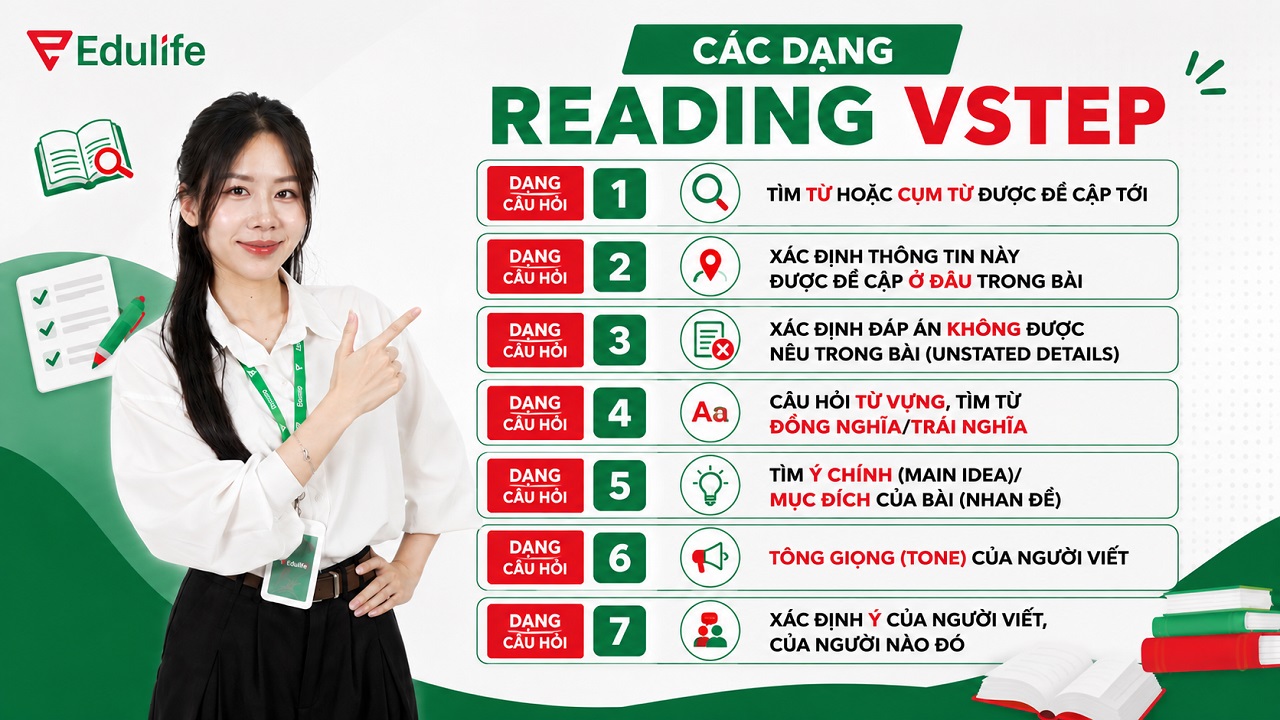
Dạng câu hỏi 1: Tìm từ hoặc cụm từ được đề cập tới
- Dấu hiệu nhận biết:
- Từ đó sẽ được IN ĐẬM hoặc để trong “NGOẶC KÉP”
- Câu hỏi sẽ có thể có từ “refers to – đề cập tới”
- Cách làm/Mẹo:
– Hãy đọc để thấy đáp án thường sẽ ở đằng trước, nhưng đọc ở đằng sau thêm để check xem đáp án mình chọn đúng hay chưa.
Ví dụ áp dụng:
Michael Collins is very lucky. He is crazy about music, and his parents help him a lot by taking him to concerts and arranging private piano and violin lessons for him.
They even drive him 50 kilometers twice a week for violin lessons. Michael’s mother knows very little about music, but his father plays the trumpet in a large orchestra.
However, he never makes Michael enter music competitions if he is unwilling.
Question : The word “They” in the passage refers to (đề cập tới cái gì) _____
- violin lessons
- concert
- Michael’s parents
- parents in general (nói chung)
Dạng câu hỏi 2: Xác định thông tin này được đề cập ở đâu trong bài
(Where question)
Dấu hiệu nhận biết:
- Có từ “Where/which line,..” trong câu hỏi
- Câu hỏi có từ “define/description,…
Cách làm/Mẹo:
- Hãy dựa vào yêu cầu của câu hỏi để tìm dòng chứa đáp án đúng
- Thường yêu cầu là mô tả – định nghĩa -> thường sau đáp án sẽ cần có từ “is” và sau “is” sẽ là 1 đoạn thông tin/cụm danh từ.
Ví dụ áp dụng:
The words “capital” and “capitol” are confused in spelling and in meaning by a lot of people who try to use them. Both their spellings and their meanings are quite closely related. A “capital” is the location of the center of government, while a “capitol” is the actual building where the government officials meet. Thus, in the United States, for example, the Capitol building is located in Washington D.C, which is the capital city of the United States.
Question: Where in the passage does the author define the word “capital”
- Line 1
- Line 3
- Line 4
- Line 7
Dạng câu hỏi 3: Xác định đáp án KHÔNG được nêu trong bài (unstated details)
Dấu hiệu nhận biết: Có từ “NOT mentioned” hoặc “EXCEPT – ngoại trừ” ở trong câu hỏi
Cách làm/Mẹo:
- Có 4 đáp án mà cần tìm 1 cái không được nêu
- Tìm 3 cái đã được nêu -> Khoanh cái không thấy
- Hãy dựa vào “danh từ” của đáp án (Gợi ý nhìn vào 2 đáp án bất kì -> tìm -> thấy = loại)
Ví dụ áp dụng:
The Florida Keys are a beautiful chain of almost 1,000 coral and limestone islands. These islands form an arc that heads first southwest and then west from the mainland. U.S. Highway 1, called the Overseas Highway, connects the main islands in the chain. On this highway, it is necessary to cross forty-two bridges over the ocean to cover the 159 miles from Miami, on the mainland, to Key West, the farthest island on the highway and the southernmost city in the United States.
Question: Which of the following is NOT mentioned about the Florida Keys?
- The Florida Keys are a chain of islands. x
- The Florida Keys contain coral and limestone. x
- The Florida Keys are in the shape of an arc. x
- The Florida Keys are not all inhabited.
Dạng câu hỏi 4: Câu hỏi từ vựng, tìm từ đồng nghĩa/trái nghĩa
- Dấu hiệu nhận biết: Có từ “closest” hoặc “best replaced by” trong câu hỏi và có 1 từ được in đậm hoặc để trong ngoặc kép.
- Cách làm/Mẹo: Hãy đọc trước và sau để hiểu ngữ cảnh, sau đó lắp các đáp án A,B,C,D vào xem đáp án nào thỏa mãn dữ liệu trước và sau của “từ đề bài cho”.
Ví dụ áp dụng:
After working for ten hours without a break, Jenny looked exhausted. She could hardly keep her eyes open and wanted to go straight to bed.
Question: The word “exhausted” is closest in meaning to
- very tired
- very excited
- very busy
- very worried
Dạng câu hỏi 5: Tìm ý chính (main idea)/ mục đích của bài (nhan đề)
Dấu hiệu nhận biết: Câu hỏi thường là “What is the main topic of the passage ?”
Cách làm/Mẹo:
- Hãy để câu này ở cuối hoặc gần cuối hằng làm -> trước đó làm câu khác -> sẽ hiểu được nội dung của văn bản
- Cần tìm đáp án “khái quát” nêu nội dung của cả văn bản
- Nếu “chỉ” thấy ở 1 chỗ nào đó, đặc biệt là “dễ thấy” mà không thấy rõ nội dung, ý nghĩa của đáp án đó thể hiện trong bài
- Có thể đáp án đó sẽ chưa đúng
- Nếu câu hỏi là về tìm nội dung của “đoạn” nào đó
- Đọc đầu/cuối của đoạn -> Sẽ thấy được nội dung cơ bản của đoạn.
Ví dụ áp dụng:
Basketball was invented in 1891 by a physical education instructor in Springfield, Massachusetts, by the name of James Naismith. Because of terrible weather in winter, his physical education students were indoors rather than outdoors. They really did not like the idea of boring, repetitive exercises and preferred the excitement and challenge of a game. Naismith figured out a team sport that could be played indoors on a gymnasium floor, that involved a lot running, that kept all team members involved, and that did not allow the tackling and physical contact of American style football.
Question : What is the topic of the passage?
- The life of James Naismith x
- This history of sports x
- Physical education and exercise x
- The origin of basketball
Dạng câu hỏi 6: Tông giọng (tone) của người viết
Giọng điệu/thái độ (tone)
Thái độ tích cực
- advisory: khuyên nên làm theo, khuyên nhủ
- complimentary: khen ngợi
- approving: ủng hộ
- persuasive: thuyết phục
- appreciative: ghi nhận
- playful: vui tươi
Thái độ tiêu cực
- sad: buồn bã
- cautionary: cảnh báo, cảnh giác
- critical: phê bình
- concerned: quan ngại, lo lắng
- sarcastic: mỉa mai
- doubtful: hoài nghi
- disapproving: không ủng hộ
Thái độ trung lập
- explanatory: giải thích
- objective: khách quan
- indifferent/unbiased/disinterested: thờ ơ, không có thái độ gì
- neutral: trung lập
- informative: cung cấp thông tin
=>
- Tập trung đọc đoạn cuối (thường thái độ được thể đoạn cuối)
- Đọc lướt tiêu đề + nắm chủ đề chung của bài viết vì thái độ của tác giả phụ thuộc vào chủ đề của bài đọc.
- Tập trung đọc đoạn cuối (thường thái độ được thể đoạn cuối)
- Đọc lướt tiêu đề + nắm chủ đề chung của bài viết vì thái độ của tác giả phụ
- thuộc vào chủ đề của bài đọc.
- Tập trung vào động từ/tính từ/cụm từ thể hiện cảm xúc thái độ loại trừ bớt đáp án sai.
Dạng câu hỏi 7: Xác định ý của người viết, của người nào đó
Dấu hiệu nhận biết: Câu hỏi sẽ có tên cụ thể của 1 người nào đó
VD: What is Richard Peto’s attitude toward smoking in China?
Cách làm/Mẹo:
- Hãy tìm tên người đó -> tìm xem câu nói của họ, thường sẽ có dấu “:” hoặc cho thấy nhận định, đánh giá, quan điểm gì đó
- Chỉ chọn đáp án thể hiện được góc nhìn, thái độ, quan điểm của họ (Đáp án đúng thường sẽ đồng nghĩa hoặc có phần y hệt)
Ví dụ áp dụng:
Câu 7 – Passage 1 – đoạn thực hành phía dưới
- Áp dụng:
Words in questions – từ vựng hữu dụng
- Passage: bài đọc
- Paragraph: đoạn đọc
- Sentence: câu
- Phrase: cụm từ
- Word: từ
- Line: dòng
- According to: theo như
- Refer to: nhắc tới, nói tới
- Replace: thay thế
- Closest in meaning: gần nghĩa
- Author (= writer: người viết, tác giả)
- Mention: đề cặp
- Describe: miêu tả
- Imply: ngụ ý (câu hỏi khó)
- Purpose: mục đích
- Attitude: thái độ
- Main idea: ý chính
- Tittle: tiêu đề
- Best tittle: tiêu đề đúng nhât
- Which of the following: đáp án nào dưới đây
- Infer: suy ra (câu khó)
Time permitted: 60 minutes Number of questions: 40
Directions: In this section you will read FOUR different passages. Each one is followed by 10 questions about it. For questions 1-40, you are to choose the best answer A, B, C or D, to each question. Then, on your answer sheet, find the number of the question and fill in the space that corresponds to the letter of the answer you have chosen. Answer all questions following a passage on the basis of what is stated or implied in that passage.
You have 60 minutes to answer all the questions, including the time to transfer your answers to the answer sheet.
PASSAGE 1: Questions 1-10
A new study, conducted by scientists from Oxford University, the Chinese Academy of Medical Sciences and the Chinese Center for Disease Control, has warned that a third of all men currently under the age of 20 in China will eventually die prematurely if they do not give up smoking.
The research, published in The Lancet medical journal, says two-thirds of men in China now start to smoke before 20. Around half of those men will die from the habit, it concludes.
In 2010, around one million people in China died from tobacco usage. But researchers say that if current trends continue, that will double to two million people – mostly men – dying every year by 2030, making it a “growing epidemic of premature death”.
But co-author Richard Peto said there was hope – if people can be persuaded to quit. “The key to avoid this huge wave of deaths is cessation, and if you are a young man, don’t start,” he said.
In many parts of China, meals often fit a comfortable pattern. After putting down their chopsticks, men commonly push their chairs back from the table and light cigarettes. No wonder China has struggled to impose a smoking ban in public places. Here, relationships are often built amid clouds of smoke.
Expensive brands of cigarettes, often decorated with gold detailing on the cartons, are given as gifts. And ordinary brands are affordable to all but the very poor, costing just 2.5 yuan ($0.4; £0.25) a pack.
In a country where smoking is so ingrained in daily life, few understand the harmful effects of tobacco use. According to the World Health Organization (WHO), only 25% of Chinese adults can list the specific health hazards of smoking, from lung cancer to heart disease.
Perhaps it should come as no surprise, then, that only 10% of Chinese smokers quit by choice. Instead, most are forced to give up their cigarettes because they’re too sick to continue.
While smoking rates have fallen in developed countries – to less than one in five in the US – they have risen in China, as cigarettes have become more available and consumers richer.
Authorities have shown concern over the rise, with Beijing even introducing a public smoking ban. But efforts have been hampered by the habit’s popularity, and its usefulness as a source of tax – the government collects about 428 billion yuan (£44billion, $67billion) in tobacco taxes each year. Globally, tobacco kills up to half of its users, according to the World Health Organization.
How many Chinese men start to smoke before the age of 20?
- one-third B. two-thirds C. half D. all of them
What does the word “those men” in paragraph 2 refer to?
- Men who smoke under the age of 20 B. Men who smoke above the age of 20
- Men who give up smoking D. Men who smoke in public
By 2030, how many men in China may die from smoking every year?
- one million B. two million C. three million D. four million
In many areas of China, when do men usually smoke?
- Before a meal B. After a meal
- Before they go to sleep D. When they get up
According to WHO, only…..of Chinese adults can list bad effects of smoking.
- one-third B. one-fourth C. one-fifth D. a half
“Beijing” refers to ……….
- China B. The city of Beijing
- The Chinese government D. People who live in Beijing
What is Richard Peto’s attitude toward smoking in China?
A.He doesn’t believe that people will give up smoking X
B.He is disappointed with the Chinese government. X
C.He thinks that people possibly stop smoking if they see reasons.
D.He is sure about the rise of future deaths in China. X
Which of the following words does the word “hamper” have closest meaning to?
- basket B. assist ~ support C. prohibit ~ ban D. restrict ~ limit
What is the writer’s purpose?
- To argue over smoking policy in China B. To support smoking in China
- To warn and prevent smoking in China D. To report the result of a research
paper
What does the writer imply about Chinese government?
- They do not want to stop people from smoking.
- They have tried to stop people from smoking in public but with little success.
- They have tried to close tobacco companies.
- They do not care about smoking.
PASSAGE 2 – Questions 11-20
The evidence that humans are causing global warming is strong, but the question of what to do about it remains controversial. Economics, sociology, and politics are all important factors in planning for the future.
Even if we stopped emitting greenhouse gases (GHGs) today, the Earth would still warm by another degree Fahrenheit or so. But what we do from today forward makes a big difference. Depending on our choices, scientists predict that the Earth could eventually warm by as little as 2.5 degrees or as much as 10 degrees Fahrenheit.
A commonly cited goal is to stabilize GHG concentrations around 450-550 parts per million (ppm), or about twice pre-industrial levels. This is the point at which many believe the most damaging impacts of climate change can be avoided. Current concentrations are about 380 ppm, which means there isn’t much time to lose.
According to the IPCC, we’d have to reduce GHG emissions by 50% to 80% of what they’re on track to be in the next century to reach this level. Is this possible?
Many people and governments are already working hard to cut greenhouse gases, and everyone can help.
Researchers Stephen Pacala and Robert Socolow at Princeton University have suggested one approach that they call “stabilization wedges.” This means reducing GHG emissions from a variety of sources with technologies available in the next few decades, rather than relying on an enormous change in a single area. They suggest 7 wedges that could each reduce emissions, and all of them together could hold emissions at approximately current levels for the next 50 years, putting us on a potential path to stabilize around 500 ppm.
There are many possible wedges, including improvements to energy efficiency and vehicle fuel economy (so less energy has to be produced), and increases in wind and solar power, hydrogen produced from renewable sources, biofuels (produced from crops), natural gas, and nuclear power. There is also the potential to capture the carbon dioxide emitted from fossil fuels and store it underground—a process called “carbon sequestration.”
In addition to reducing the gases we emit to the atmosphere, we can also increase the amount of gases we take out of the atmosphere. Plants and trees absorb CO2 as they grow, “sequestering” carbon naturally. Increasing forestlands and making changes to the way we farm could increase the amount of carbon we’re storing.
Some of these technologies have drawbacks, and different communities will make different decisions about how to power their lives, but the good news is that there are a variety of options to put us on a path toward a stable climate.
The word “we” in paragraph 2 refers to ………..
- humans B. economists, sociologists, and politicians
- animals D. scientists
According to paragraph 2, how many degrees could the Earth warm up?
- 2.5 B. 2.5 or 10 C. 10 D. from 2.5 to 10
According to paragraph 3, why should we stabilize GHG concentrations around 450-550 parts per million?
A.to avoid the most serious effects of climate change
B.to avoid all damaging impacts of climate change
C.to mend the most damaging impacts of climate change
D.to stop climate change
What does “which” in paragraph 3 refer to?
A.current concentrations
- that current concentrations are about 380 ppm
- 380 ppm
- ppm
Why does the author mention Stephen Pacala and Robert Socolow?
A.To introduce two researchers in the field
B.To prove that researchers are working to reduce GHG emission
C.To introduce one way to reduce GHG emission
D.To introduce Princeton University
What stabilization wedges are NOT mentioned in the passage?
A.create environment-friendly materials
B.capture and store carbon dioxide underground x
C.increase the use of renewable energy x
- grow more trees x
What does “them” refer to?
- researchers B. humans C. renewable resources D. wedges
What is the best title for this passage?
- Arguments over Global Warming B. Global Warming and its Causes
- Global Warming Solutions D. Global Warming’s Effect on Earth
“Sequestering” has closest meaning to ……….
- absorb B. isolate C. release D. emit
Why does the writer mention “drawbacks” in the last paragraph?
- To introduce the disadvantages of solutions in the following paragraph
- To emphasize the disadvantages of the solutions in the previous paragraph
- To recommend readers not to use the solutions
- To emphasize the advantages of the solutions in different contexts
PASSAGE 3 – Questions 21-30
Art communicates to us primarily through our eyes. We look at art, and we try to find some meaning in the experience. If we are to begin to think about art more seriously, we might do well to become more aware of the process of seeing itself.
Science tells us that seeing is a mode of perception, or the recognition and interpretation of sensory data-in other words, how information comes in our senses, and what we make of it. In visual perception our eyes take in information in the form of light patterns; the brain processes these patterns to give them meaning. The mechanics of perception work much the same way for everyone, yet in a given situation we do not all see the same things.
We can take great pleasure in merely looking at art, just as we take pleasure in the view of a distant mountain range or watching the sun set over the ocean. But art, unlike nature, is a human creation. It is one of the many ways we express ourselves and attempt to communicate. A work of art is the product of human intelligence, and we can meet it with our own intelligence on equal footing. This is where study comes in.
The understanding of process – the how – often contributes quite a lot to our appreciation of art. If you understand why painting in watercolor may be different from painting in oil, why clay responds differently to the artist’s hands than does wood or glass – you will have a richer appreciation of the artist’s expression.
Knowing the place of a work of art in history – what went before and came after – can also deepen your understanding. Artists learn to make art by studying the achievements of the past and observing the efforts of their contemporaries. They adapt ideas to serve their own needs and then bequeath those ideas to future generations of artists. For example, Matisse assumed that his audience would know that Venus was the ancient Roman goddess of love. But he also hoped that they would be familiar with one Venus in particular, a famous Greek statue known as the Venus de Milo.
An artist may create a specific work for any of a thousand reasons. An awareness of the why may give some insight as well. Looking at Van Gogh’s The Starry Night, it might help you know that Van Gogh was intrigued by the belief that people journeyed to a star after their death, and that there they continued their lives. “Just as we take the train to get to Tarascon or Rouen,” he wrote in a letter, “we take death to reach a star.” This knowledge might help you understand why Van Gogh felt so strongly about the night sky, and what his painting might have meant to him. But no matter how much you study, Van Gogh’s painting will never mean for you exactly what it meant for him, nor should it. Great works of art hold many meanings.
The greatest of them seem to speak anew to each generation and to each attentive observer. The most important thing is that they mean something for you, that your own experiences, thoughts, and emotions find a place in them.
According to paragraph 2, the process of visual perception ………..
- is not the same for all people B. begins with patterns of light
- is not very scientific D. requires other senses to function
What did Matisse reinterpret?
- A goddess from mythology B. A painting by another artist
- An ancient sculpture D.A man in history
The word “them” in the last paragraph refers to ……….
- each attentive observer B. thoughts and emotions
- a lifetime of experiences D. great works of art
The word “bequeath” in the passage is closest in meaning to ……………
- make out B. pass on C. look over D. take in
The author mentions all of the following ways to enhance the appreciation of art EXCEPT
- understanding the artistic process B. becoming familiar with the history
- experiencing the art by copying D. knowing about the life of the artist
What is the main topic of this passage?
- Visual perception of sensory material
- The historical context for artistic expression
- Studying Van Gogh’s The Starry Night
- The appreciation of works of art
Which of the sentences below best expresses the information in the highlighted statement in the passage?
- We see images differently because of the mode of perception.
- Although we see images differently, the mode of perception is similar.
- Since the mode of perception is similar, we see images in the same way.
- When the mode of perception is the same, we see the same images
Why might Van Gogh have painted The Starry Night?
- To symbolize the journey of life after death
- To create a dramatic contrast with the sky
- To place a strong image in the foreground
- To include nature from his early experience
The word “intrigued” in the passage is closest in meaning to ………..
- very pleased B. very confused C. very interested D. very surprised
What can be inferred from the last paragraph?
- Greatest artworks are impossible to understand.
- The author shows negative feelings toward contemporary art.
- People need knowledge to understand art.
- What we see in art is determined by our emotions, experiences, and thoughts.
PASSAGE 4 – Questions 31-40
Antibiotics block the life cycle of bacteria that invade the human body. The first of these antibiotics, penicillin, works by blocking the molecules that construct the cell walls of particular bacteria. The bacteria, with incomplete cell walls, are not able to reproduce.
When penicillin was introduced during World War II, it was truly a “miracle drug.” Until that time, anyone who was cut or wounded stood a great risk of infection. Once penicillin became available, the situation changed. Wounded soldiers, children with ear infections, and many others began to benefit from the ability to block the growth of bacteria.
While humanity may have won that particular battle against bacteria, the war is far from over. The reason is that in any bacterial population, there are bound to be a few bacteria that, for one reason or another, are not affected by a particular antibiotic. For example, they may have a slightly differently shaped enzyme that builds cell walls, so that penicillin will not fit onto that particular shape of the enzyme. These bacteria will not be affected by that particular drug.
For that small group, the antibiotic is a real godsend. It doesn’t affect them, but it does wipe out all of their competition. They are thus free to multiply, and, over time, all of the bacteria will have whatever properties that made those individuals resistant.
Traditionally, medical scientists have dealt with this phenomenon by developing a large number of antibiotics, each of which intervenes in the bacterial life cycle in a slightly different way.
Consequently, if you happen to have a bacterium that is resistant to one antibiotic, probably it will succumb to the action of another. You may, in fact, have had the experience of going to a doctor with an infection, being given an antibiotic, and then finding that it didn’t work. In all likelihood, all your doctor had to do then was prescribe a different antibiotic and everything was fine.
The problem is that as time has passed, more and more bacteria have become resistant to antibiotics. In fact, currently, there is one strain of bacteria-
Staphylococcus-that is resistant to every commercially available antibiotic except one, and in 1996, a bacterium with lowered resistance to that last antibiotic appeared in Japan.
The appearance of drug-resistant bacteria is not particularly surprising; in fact, it probably should have been anticipated. Nevertheless, in the late 1980s, there was a general sense of complacency among scientists on the antibiotic question. Little profit was to be made by developing the one-hundred-and-first antibiotic. Drug companies concentrated their efforts on other areas. Therefore, a gap developed between the production of new antibiotics and the development of resistance among bacteria.
By the early 1990s, this gap was recognized and highlighted in several national news magazines. More companies returned to develop new kinds of antibiotics, and currently, a number are undergoing clinical trials. By early in the twenty-first century, some of these new drugs will start to come on the market, and the problem will be “solved,” at least for the moment.
Additional research will focus on the processes by which cells repair the constant damage to DNA, but the computer design of new drugs, the development of new antibiotics, and techniques to combat bacteria should remain a top priority.
How do antibiotics treat infections?
- They interfere with the reproductive cycle of bacteria.
B.They construct cell walls to resist bacteria.
- They inject enzymes that explode in affected cells.
- They increase the mitosis of healthy cells
The word “them” in paragraph 4 refers to ……….
- whatever properties B. resistant bacteria
- their competition D. those individuals
The word “anticipated” in the passage is closest in meaning to …….
- predicted B. concealed C. investigated D. disregarded
Which of the following best expresses the main idea of this passage?
- The “miracle drug” penicillin B. Drug-resistant bacteria
- Staphylococcus infections D. Gene therapy treatments
According to paragraph 4, why do some bacteria benefit from antibiotics?
- The antibiotic eliminates competing bacteria, allowing resistant bacteria to reproduce.
- The resistant bacteria compete with the antibiotic, and the bacteria become stronger.
- The competition helps the resistant bacteria to multiply by reproducing with the resistant type.
- The properties of the antibiotic are acquired by the bacteria, making it resistant to the competition.
The word “complacency” in the passage is closest in meaning to ……
- consensus of agreement B. fear of consequences
- lack of concern D. awareness of potential
Which of the sentences below best expresses the information in the highlighted statement in the passage?
- Some antibiotics affect a population of bacteria more efficiently than others.
- There are several reasons why some bacteria do not respond to most antibiotics.
- The effect of antibiotics on bacteria is to bind them together into one population.
- A small number of bacteria in any sample will probably be resistant to a specific antibiotic.
The author mentions all of the following reasons for drug resistant bacteria to appear EXCEPT…….
- there was not enough profit incentive for companies to continue developing new antibiotics
- statistically, some drug-resistant bacteria will occur naturally in any large population of bacteria
- the newer antibiotics were not as strong and effective as the original penicillin-based drugs
- competing bacteria are destroyed by antibiotics, allowing resistant bacteria to prosper.
It can be inferred from the passage that …….
- research to develop new antibiotics will not be necessary in the future
- the scientific community was not surprised by the resistant strains of bacteria
- antibiotics are not very expensive when they are made available commercially
- it takes years for a new drug to be made available commercially for consumers
Which of the following statements is NOT a main idea of the passage?
- Many strains of bacteria have become resistant to the antibiotics currently available.
- Funding for the production of new antibiotics has been allocated to drug companies.
- The first antibiotics were very effective in blocking the reproduction of bacteria.
- New antibiotics are being developed to combat bacteria that resist the older antibiotics.
Đừng để phần thi Reading VSTEP làm rào cản trên hành trình chinh phục chứng chỉ của bạn! Đăng ký khóa học tại Edulife ngay hôm nay để làm chủ chiến thuật giải đề thực chiến, bứt phá band điểm B2, C1 cấp tốc và tự tin cầm chắc tấm bằng trong tay.